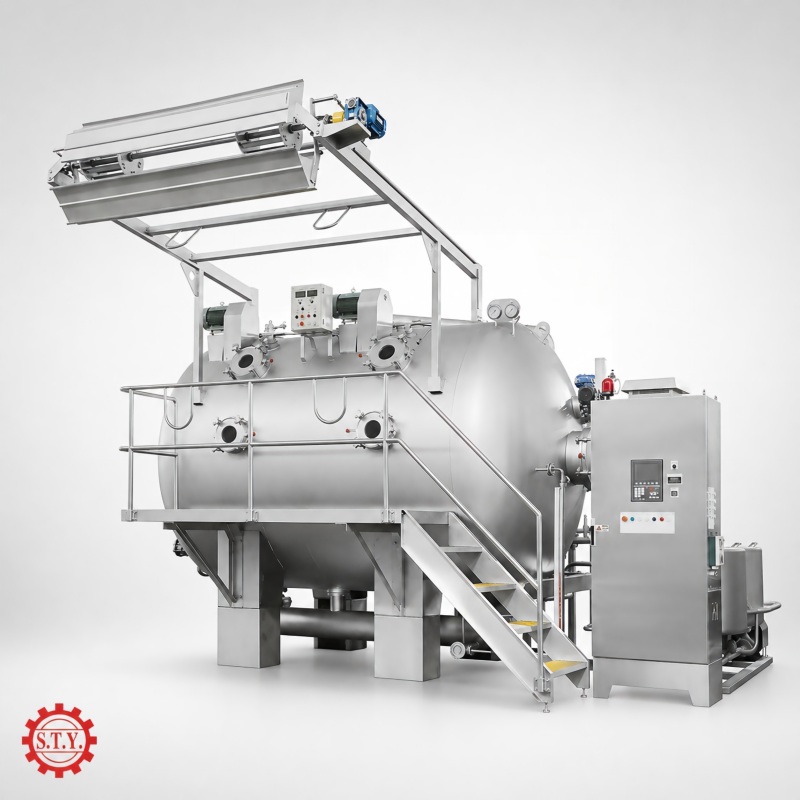
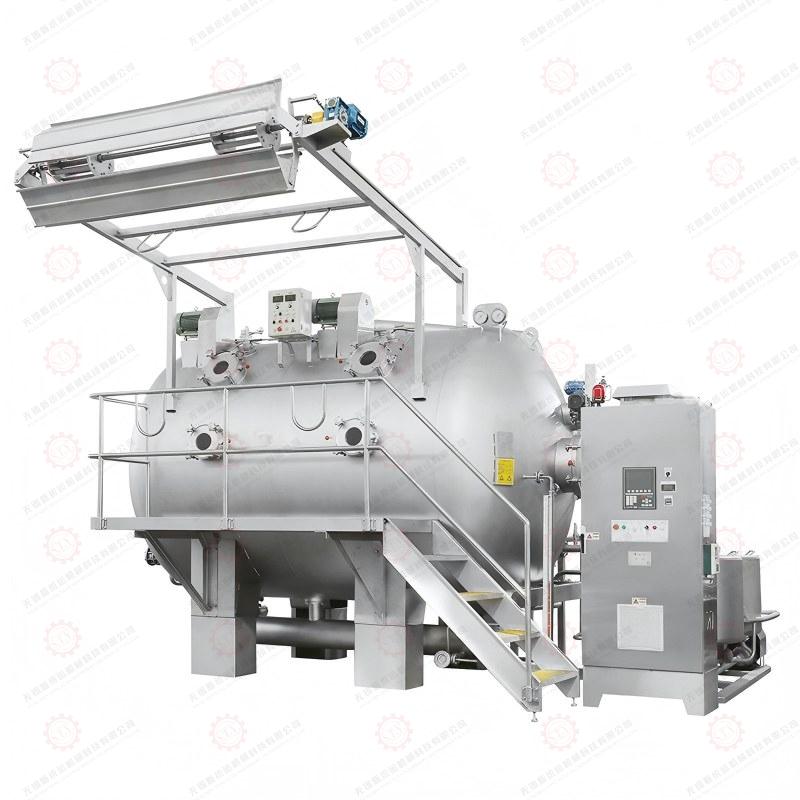
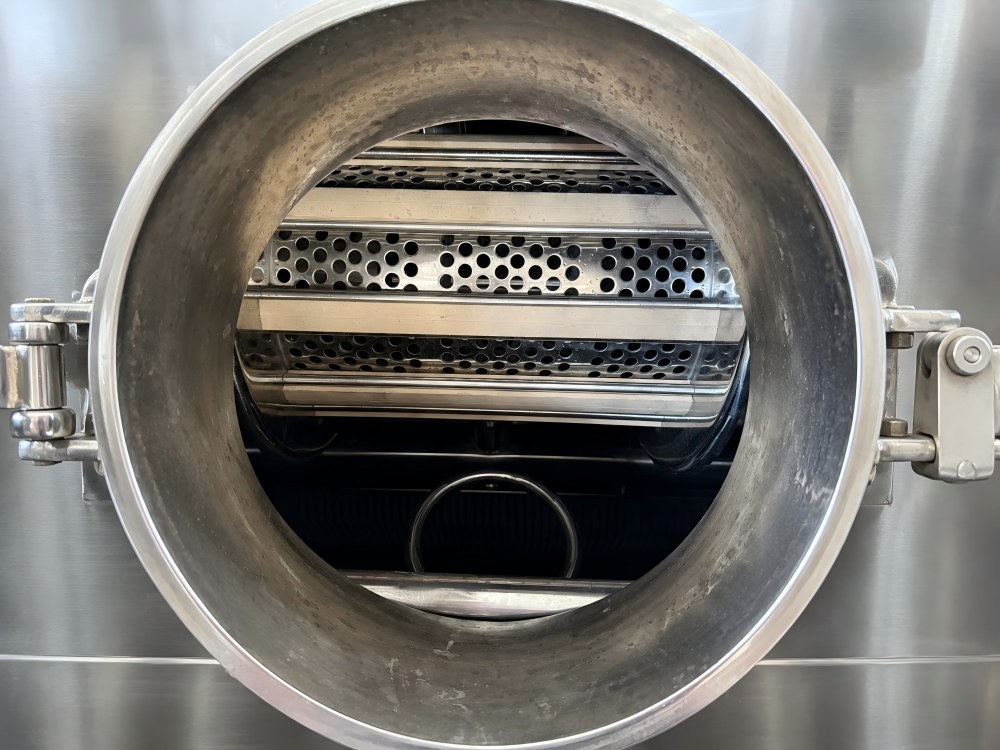
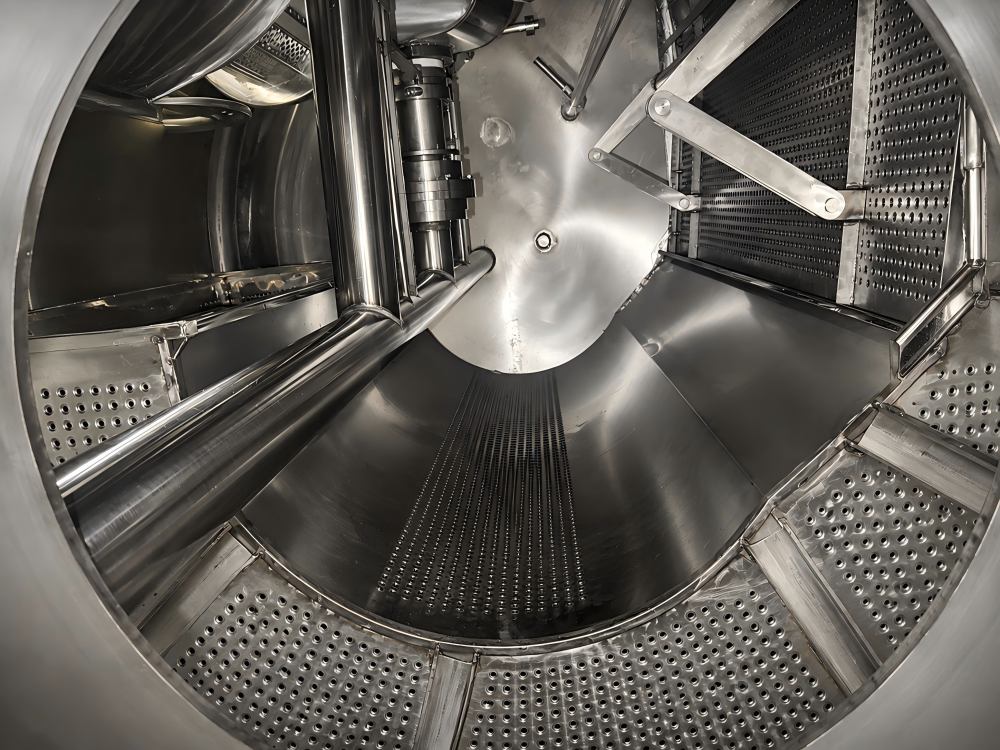
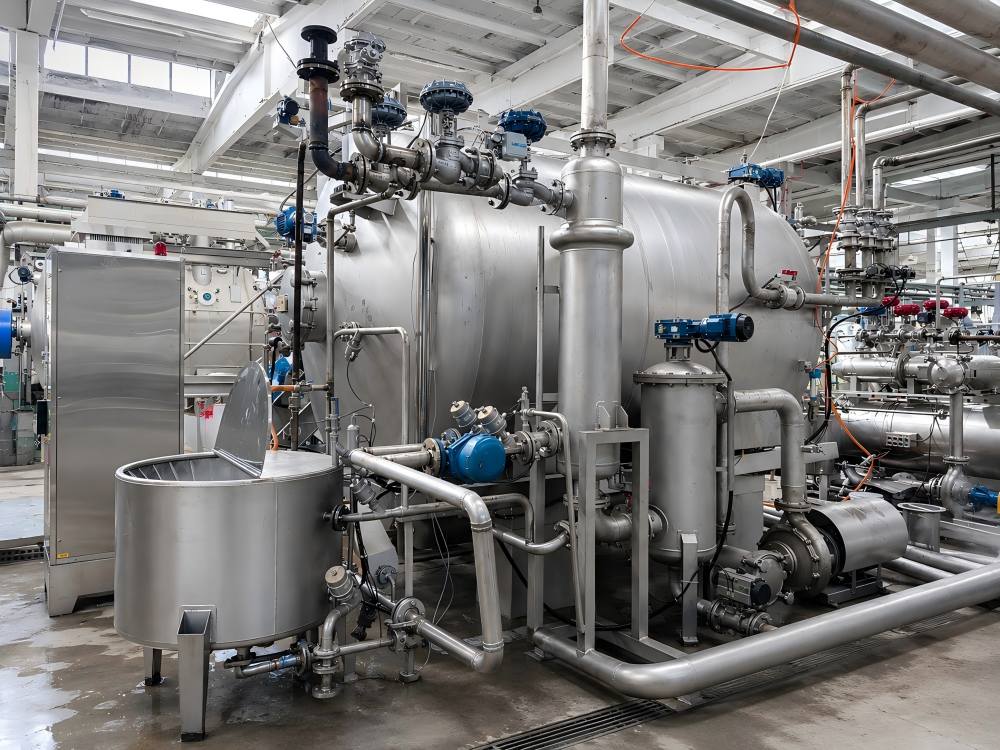
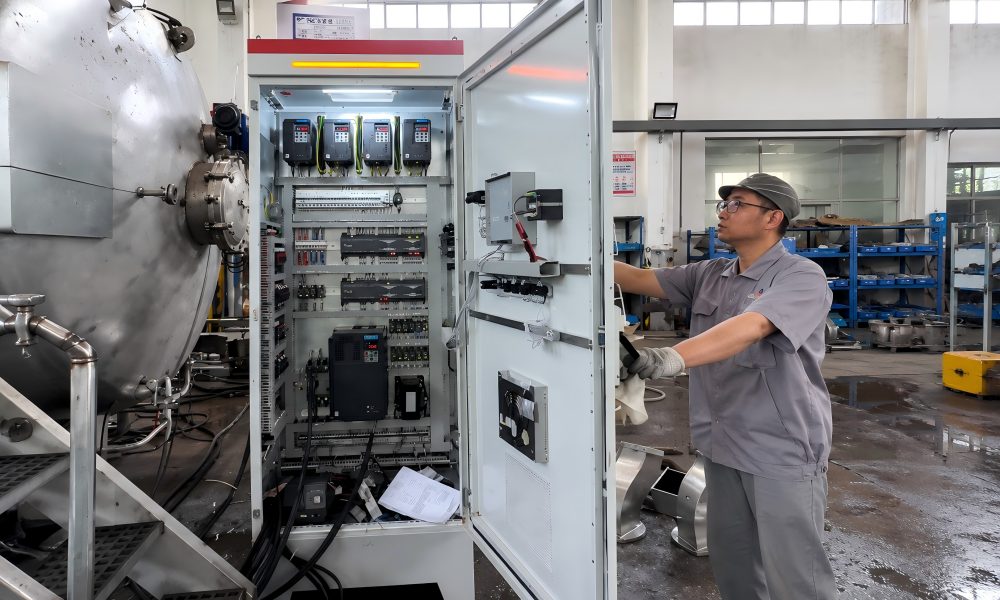
TY-SF is a low tension fabric dyeing machine designed for knitted, elastic and tension-sensitive fabrics. Internal lifting wheel keeps fabric lifting height within approximately 80 cm, reducing mechanical tension during circulation and helping minimize stretching, creasing and fabric deformation.
With liquor ratio around 1:4.5, fabric speed up to 450 m/min and applicable fabric weight around 50–350 GSM, TY-SF supports stable fabric movement, lower water consumption and automated dyeing production.
Machine integrates internal lifting wheel, optimized dye liquor circulation, adjustable nozzle system, proportional steam control and automatic lint removal system for stable and uniform dyeing.
Why TY-SF Uses an Internal Lifting Wheel
In conventional fabric circulation systems, fabric often travels through a relatively high lifting path before returning to dyeing chamber. For soft, elastic or lightweight knitted fabrics, excessive lifting height may increase mechanical tension, stretching and deformation.
TY-SF places lifting wheel inside machine body and keeps fabric lifting height within approximately 80 cm.
Shorter fabric transport path helps:
- Reduce mechanical tension on fabric rope
- Minimize stretching and elongation
- Reduce risk of creasing and rope marks
- Maintain stable fabric circulation
- Improve handling of elastic and tension-sensitive knitted fabrics
Internal lifting wheel structure is one key difference between TY-SF and conventional overflow fabric dyeing machines. For more information about tension, creasing and fabric movement, see our low tension dyeing solutions for knitted fabric.
Low Tension Dyeing for Knitted and Elastic Fabrics
TY-SF is mainly designed as a knitted fabric dyeing machine for fabrics requiring low mechanical tension during dyeing.
Typical applications include:
- Knitted fabrics
- Elastic knitted fabrics
- Spandex-containing fabrics
- Lightweight to medium-weight fabrics
- Fabrics sensitive to stretching or deformation
- Processes requiring stable circulation and uniform color
Machine selection should consider material composition, GSM, width, elasticity, batch capacity and required dyeing process.
Low Liquor Ratio and Dye Liquor Circulation
TY-SF operates with liquor ratio around 1:4.5 under suitable loading and process conditions.
Lower liquor ratio can help reduce:
- Water consumption
- Steam demand
- Dye liquor volume
- Chemical and auxiliary consumption
- Wastewater discharge per batch
Dye liquor circulation system maintains continuous liquor exchange between fabric and dye bath while reducing dead zones inside machine.
Stable circulation helps improve:
- Dye penetration
- Levelness
- Batch consistency
- Color uniformity between tubes
Actual liquor ratio and process consumption depend on fabric type, loading condition and dyeing recipe.
Adjustable Nozzle and Process Control
Adjustable High-Flow Nozzle
TY-SF uses adjustable nozzle system to match different fabric structures and operating conditions. Nozzle system controls fabric transport and dye liquor exchange while maintaining stable circulation.
Depending on fabric characteristics, nozzle settings can be adjusted to balance:
- Fabric running speed
- Fabric tension
- Dye liquor flow
- Dye penetration
- Process stability
For elastic and lightweight fabrics, proper nozzle adjustment is particularly important for avoiding excessive fabric stress.
Proportional Steam Control
Heating system uses proportional steam control for stable temperature regulation during dyeing. Controlled heating and cooling rates can be set according to process requirements, helping improve batch-to-batch reproducibility.
Automatic Lint Removal System
Automatic lint removal system continuously removes loose fibers and lint from circulating dye liquor.
This helps:
- Reduce lint accumulation
- Maintain circulation efficiency
- Reduce blockage risk
- Simplify routine cleaning and maintenance
TY-SF Technical Specifications
| Specification |
TY-SF |
| Machine Type |
Internal Lifting Wheel Fabric Dyeing Machine |
| Main Application |
Knitted and elastic fabrics |
| Applicable Fabric Weight |
Approx. 50–350 GSM |
| Liquor Ratio |
Approx. 1:4.5 |
| Fabric Speed |
Up to 450 m/min |
| Capacity per Tube |
Approx. 350 kg |
| Fabric Lifting Height |
≤80 cm |
| Fabric Transport |
Internal lifting wheel |
| Process Feature |
Low tension circulation |
| Lint Removal |
Automatic lint removal system |
| Control |
Full automatic |
| Controller |
HG standard / SEDO optional |
Actual capacity, liquor ratio and operating parameters depend on fabric construction, GSM, width, elasticity and process conditions.
TY-SF vs TY-JL636: Which Fabric Dyeing Machine Should You Choose?
Both TY-SF and TY-JL636 top-running overflow fabric dyeing machine can process knitted fabrics, but machine structures and application priorities differ.
| Selection Point |
TY-SF |
TY-JL636 |
| Machine Structure |
Internal lifting wheel |
Top-running overflow |
| Main Priority |
Low tension and low liquor ratio |
Wider fabric adaptability |
| Typical Fabric Range |
Knitted, elastic and tension-sensitive fabrics |
Knitted, elastic and wider GSM range fabrics |
| Fabric Weight |
Approx. 50–350 GSM |
Approx. 50–2000 GSM |
| Liquor Ratio |
Approx. 1:4.5 |
Approx. 1:6–7 |
| Fabric Lifting |
Internal lifting wheel, ≤80 cm |
Top-running circulation |
| Typical Capacity |
Approx. 350 kg per tube |
250 / 500 / 1000 kg models |
TY-SF is generally considered when low mechanical tension, lower liquor ratio and automated operation are key requirements.
TY-JL636 may be more suitable for dyehouses processing wider fabric weight ranges or requiring greater flexibility across different knitted fabric constructions.
For detailed machine selection, see our Fabric Dyeing Machine Application Guide.
Information Needed for TY-SF Model Selection
For TY-SF configuration recommendation, please provide:
- Fabric material, such as cotton, polyester, nylon or blends
- Knitted fabric structure
- Fabric GSM
- Fabric width
- Elastic or spandex content
- Required batch capacity
- Daily production target
- Maximum dyeing temperature
- Available steam pressure
- Electrical supply
- Main quality concerns, such as creasing, stretching or deformation
Based on these details, we can evaluate TY-SF suitability and recommend suitable machine configuration.
FAQ About TY-SF Fabric Dyeing Machine
1. What fabrics are suitable for TY-SF?
TY-SF is mainly suitable for knitted, elastic and tension-sensitive fabrics, especially fabrics where low mechanical tension and stable circulation are important.
2. What is the liquor ratio of TY-SF?
TY-SF operates at approximately 1:4.5 under suitable loading and process conditions. Actual liquor ratio may vary with fabric structure, GSM and batch loading.
3. Why does TY-SF use an internal lifting wheel?
Internal lifting wheel keeps fabric lifting height within approximately 80 cm, helping reduce mechanical tension, stretching, creasing and deformation during circulation.
4. What is the typical capacity of TY-SF?
Typical capacity is approximately 350 kg per tube. Final capacity depends on fabric GSM, width, construction and loading conditions.
5. How is TY-SF different from TY-JL636?
TY-SF focuses more on low tension, lower liquor ratio and elastic or tension-sensitive knitted fabrics. TY-JL636 offers wider fabric weight adaptability and broader knitted fabric applications.
Request TY-SF Machine Recommendation
TY-SF is designed for dyehouses processing knitted and elastic fabrics where low tension, stable circulation and lower liquor ratio are important.
Send fabric specifications and target batch capacity. Our team can evaluate application conditions and recommend suitable machine configuration, control system and production setup.